I live in one of the more family-friendly parts of

Adults dressed as children: the blue remembered hills of west London
These are the parts of London

The District Line platform at Earls Court, W5
In less obvious numbers are the tenants in local authority housing – for some no doubt laudable but unexplored reason they are no longer called ‘council houses’ – whose dwellings, in terraced houses almost infinitely subdivided into rooms within rooms, are distinguishable from the privately-owned homes because their ground floors have net curtains in the windows instead of those vile plasticised wooden shutters or opque sticky-backed plastic film - and, let us be frank, by their skin tone. Here also are pockets of guests, invited or otherwise, some from those parts of the globe where British forces have in the last twenty years or so been rushed in on the errands of optimistic fools, adventures exploited latterly to provide a fig-leaf of humanitarian credentials to justify the more 'kinetic' adventures in social engineering in more minerally-blessed regions.
Other residents are here because the ‘civilised,’ ‘moderate’ and 'decent' social policy of previous governments - as opposed to the uncivilised, ignorant, extremist and barbaric policies of every government prior to, ooo, about 1997 - demanded for their sustainability a healthy and visible ‘diversity’ of appearance among our island population, to sustain the fiction that Britain has a long tradition of 'welcoming' huge intakes of visitors from overseas and incorporating them without social upheaval. The economic and industrial policies of those same governments have ensured that the only way to support the ‘living standards’ of the modern Briton [sic], who is for the most part too stupefied by drink and drugs or enfeebled by a devotion to pornography, to summon the ire to procreate, is to import the labour, re-distribute it in pockets hither and yon, and not enforce too strenuously the observance of regrettable formalities such as visas.
Here, in my beautiful neighbourhood, a man may, as his circumstances dictate, sit in his front room, scratching himself to the heady tinnitus of some cutting-edge dub-step, with a tin of Hawk in his hand, pausing only to bray the kids - or, like your author, lounge languidly in the parlour and regard from behind a copy of The missing will and those afore-mentioned shutters, with a glass of something from the Cote d’Or delicately balanced between forefinger and thumb - watch those new arrivals integrate with the existing community.
Truly, all human life is here, and if one can deplore the demographic and macro-economic trends that make this inevitable, one can at least draw some enjoyment from the sight of 'the other'.
One of the other joys of the neighbourhood is the proximity to a park, where I often take Bumwad Junior for some fresh air and diversion. She has graduated recently from the swings to the climbing frame, and, gradually understanding the effects of, if not the science behind, friction, is mastering the ‘feet up’ position needed to negotiate the slide at speed.
Truly, all human life is here, and if one can deplore the demographic and macro-economic trends that make this inevitable, one can at least draw some enjoyment from the sight of 'the other'.
One of the other joys of the neighbourhood is the proximity to a park, where I often take Bumwad Junior for some fresh air and diversion. She has graduated recently from the swings to the climbing frame, and, gradually understanding the effects of, if not the science behind, friction, is mastering the ‘feet up’ position needed to negotiate the slide at speed.
Joyous though it is to watch BuJu enjoying herself in a safe environment, however, what keeps me entertained on these occasionally repetitive visits – although it is important to keep an open mind, it is fairly clear to me that, if you’ve seen one slide, you’ve seen many; and fart around as they might with palettes and textures, I’m forming the view that there is little that the creative geniuses of Image Playgrounds Ltd can do to surprise me – is people-watching. And it will not surprise either of my readers to learn that it is the habits of dress as much as anything else that I ponder; and that I am most pre-occupied by the regrettable laxity of dress exhibited by the adult male.
One of the themes emerging from earlier threads is the yawning gap between the sexes with regard to standards of turn-out in public, perhaps most vivid at weddings, but equally conspicuous in most of our shared public space.

Now of course it is possible to exaggerate - for reasons no doubt of psychosexual problems connected with the Church and one’s own childhood - the standards of appearance of the modern Englishwoman. Certainly if one were to abandon all sense of propriety and throw a stone at random down the local high street, it would stand as much chance of striking a sullen, inarticulate drab in low-slung tracksuit trousers and fake Uggs as it would of bouncing off the bonce of a suburban goddess like Betty Draper Francis. But even if such an idealised form of the lover-housewife-mother-of-God exists only in the imaginations of writers of modern US TV drama and 1970s BBC sitcoms, at the park or the birthday party the Yummy Mummy has no masculine equal.

January Jones: a rarely sighted on the British high street
January Jones: a rarely sighted on the British high street
But what is also obvious is the extent to which modern Englishmen are not only far less presentable than their wives, but now are routinely trounced in the style stakes by their offspring. Time was that children were dressed as smaller versions of their parents. I recall as a boy being forced into 'my party clothes', which were essentially child-sized versions of the clothes the adults in my family wore - dark cords or faux flannel 'slacks,' proper collared shirts, a pullover and, I expect at some point, a clip-on elasticated bow-tie (which, admittedly neither my dad nor his dad would ever have worn).
This is still true up to a point, but it cannot be coincidence that the best-quality childrenswear is continental or northern American in origin: Marie Chantal, La stupenderia, Bonpoint, Rachel Riley, H&M, Gap, Petit bateau etc. Only the Little White Company and Trotters really fly the English (if made in Malaysia) flag. All of these places enabe to dress your child traditionally, if not cheaply, as a sort of 'mini-me' of the idealised preppy/Eurotrash/Sloane uniform.
But if little Charlotte, Sophia and Lily are miniature versions of their mothers, the kit worn by George, Ludo, Jake and Mohammed to Cosmo's fifth birthday party is almost certain to bear no resemblance to any outfit that their fathers have worn since leaving boarding school. Indeed, far from being a suitable sartorial role model for his young son, the modern British dad is more likely to dress like his ten-year old self – to dress more childishly than his own children.
This, I can only speculate, is because the mother dresses the child, and brings to the task the sense of propriety evident in her own typically high standards.
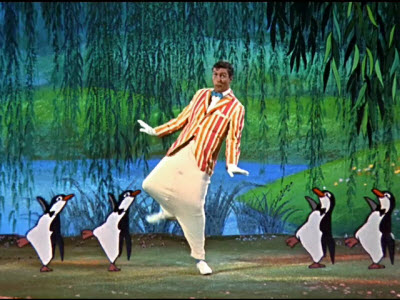
So let us behold the modern male - the middle class version by far the most egregious offender because he should know better - left to his own devices and 'free' to assemble from his wardrobe some suitable 'leisure-wear' for the same party. Here he comes, shuffling up the path in his shop-faded and distressed denim 'jeans', the crotch of which - whether he wears a belt or not - hangs between groin and thigh, so that he could in silhouette pass for Dick van Dyke’s penguin impersonation in Mary Poppins. Above the waistband of these poke his undergarments, turning this most intimate of apparel into a crude and intrusive advertising hoarding for a pants-peddler, and thus which for its intended effect demands that it be visible, inverting the traditional and surely correct purpose of underclothes. His t-shirt advertises a television programme, a band or a film, or might contain an obscene or 'ironic' slogan, but is in any event unlikely to be free from a design of some sort.
If he wears a shirt – and there’s formal for you! – and if it has tails, it will announce the fact as they protrude from his clothes - violating the very purpose they serve. His sneakers are laced badly, if they are laced at all - it is rare that I find myself at one with the Health & Safety Executive but that surely is no practical example to an infant.
In extremities of cold weather he sports an artificial-fibre fleece or other leisure wear - redolent more of the north face of the Fellhorn than the North End Road - and resembles nothing so much as an infant in a romper suit. The ubiquitous beeny hat crops his skull, giving it the ovoid, featureless appearance of the babe in arms, and conceals, if not male pattern baldness then probably not a haircut but a hairstyle - probably the only aspect of his appearance to which he has given any but cursory thought, and quite possibly spending longer 'styling' it, and with more products, than his wife.
This is still true up to a point, but it cannot be coincidence that the best-quality childrenswear is continental or northern American in origin: Marie Chantal, La stupenderia, Bonpoint, Rachel Riley, H&M, Gap, Petit bateau etc. Only the Little White Company and Trotters really fly the English (if made in Malaysia) flag. All of these places enabe to dress your child traditionally, if not cheaply, as a sort of 'mini-me' of the idealised preppy/Eurotrash/Sloane uniform.
But if little Charlotte, Sophia and Lily are miniature versions of their mothers, the kit worn by George, Ludo, Jake and Mohammed to Cosmo's fifth birthday party is almost certain to bear no resemblance to any outfit that their fathers have worn since leaving boarding school. Indeed, far from being a suitable sartorial role model for his young son, the modern British dad is more likely to dress like his ten-year old self – to dress more childishly than his own children.
This, I can only speculate, is because the mother dresses the child, and brings to the task the sense of propriety evident in her own typically high standards.
So let us behold the modern male - the middle class version by far the most egregious offender because he should know better - left to his own devices and 'free' to assemble from his wardrobe some suitable 'leisure-wear' for the same party. Here he comes, shuffling up the path in his shop-faded and distressed denim 'jeans', the crotch of which - whether he wears a belt or not - hangs between groin and thigh, so that he could in silhouette pass for Dick van Dyke’s penguin impersonation in Mary Poppins. Above the waistband of these poke his undergarments, turning this most intimate of apparel into a crude and intrusive advertising hoarding for a pants-peddler, and thus which for its intended effect demands that it be visible, inverting the traditional and surely correct purpose of underclothes. His t-shirt advertises a television programme, a band or a film, or might contain an obscene or 'ironic' slogan, but is in any event unlikely to be free from a design of some sort.
If he wears a shirt – and there’s formal for you! – and if it has tails, it will announce the fact as they protrude from his clothes - violating the very purpose they serve. His sneakers are laced badly, if they are laced at all - it is rare that I find myself at one with the Health & Safety Executive but that surely is no practical example to an infant.
In extremities of cold weather he sports an artificial-fibre fleece or other leisure wear - redolent more of the north face of the Fellhorn than the North End Road - and resembles nothing so much as an infant in a romper suit. The ubiquitous beeny hat crops his skull, giving it the ovoid, featureless appearance of the babe in arms, and conceals, if not male pattern baldness then probably not a haircut but a hairstyle - probably the only aspect of his appearance to which he has given any but cursory thought, and quite possibly spending longer 'styling' it, and with more products, than his wife.
Allow me a moment as I try to recall occasions on which my grandfather deliberately displayed his underwear or had his shirt-tails hanging out in a public space…
Nope... Nothing springs to mind.
Well, I do not say definitively that this occurrence could never have happened. It is in fact possible to hypothesise circumstances in which both events might indeed have come to pass, although surely the two developments would be related, and gin would probably be a common factor if there were no other. But it would have been a point of shame for him, an example of a regrettable lapse of judgement or sobriety. It would certainly not have arisen as a result of a deliberate decision, made with a clear head, that it was acceptable to leave the house in such a state, still less that it would be regarded by his peers, not as an embarrassing error requiring immediate correction, but as a ‘valid’ ‘expression’ of his ‘lifestyle’. That it is possible for young men to entertain such beliefs, and for those who shape and dictate 'style' to those impressionable and vulnerable waifs to encourage them in that, surely erroneous, belief before my grandfather's cohort are even cold in the ground illustrates the dizzying speed with which our standards deteriorate, and the difficulties inherent in any attempt to not only arrest but reverse that decline. It surely cannot be too alarmist to predict that, within the lifetime of my younger readers, it will be acceptable for an adult British male to wear a nappy and suck on a dummy.

The Member for Kirkcaldy and Cowdenbeath relaxing at home.
How has this come to pass, and why is it sustained?
The brilliant Michael Bywater - I feel like I demean him just by citing him in this blog - addresses this tendency in his excellent Big Babies (link opposite and extract here) where he notes the distinction between a hat and a 'hat' - that it is now impossible simply to wear a hat, and that doning that item makes you, to other people, 'a hat wearer'. All our consumer choices have been made - by advertisers and that strange breed known once as 'trouser journalists', their parasites in the 'style' media - into 'lifestyle' choices, in which once-simple decisions - 'It is starting to get cold. I need a hat.' - have significance forced upon them. Bywater - forget Craig Brown, he is the funniest writer in England today, a sort of print Jonathan Meades - de-constructs advertising and 'brand positioning' for watches, targeting Pulsar and Seiko (pitting what the advertiser tells you that 'owning a Pulsar' says about you against what owning one really says about you - which is best summed up as 'I can't afford a Seiko') and the phenomenon of the pilot's watch.
He is particularly sharp on the dismal Patek Phillipe adverts run in the Spectator - the ones populated by generically 'handsome' models presumably chosen for their fancied resemblence to, for example, a southern European aristocrat who looks like he has a successful carrer in global finance, or at least a Home Counties bigamist doing a passable impression of one, looking paternal towards a sullen and badly-raised IdentiKit son, staring with dumb insolence beyond the camera to the nasty plebs, a demeanour occasioned no doubt by the realisation that his parents have pimped his arse to the agency for money.
'You never actually own a Patek Philippe. You merely look after it for the next generation.' As Bywater notes, the 'actually' and 'merely', despite appearing redundant in terms of the construction of the sentence, are crucial. If you never 'actually own' one, implicitly you 'never actually' spend the £3,000 to buy one; and if it's really for young Konrad here, why, it's not being selfish, it's an investment; et, entertainingly, cetera...

Arbeit macht frei, Kraft durch Freude etc
He then goes on describes a former neighbour who had a 'hunter-gatherer' uniform for his trips to Waitrose - the full early 80s Sloane Ranger get-up, Hunter wellies, Barbour, Tattersall check shirt, tweed coat, flat cap etc.
While Bywater is, to my mind, spot on in the fraudulence and pretty transparent insinuations of the advertising-trouser hack interface of deceit, he doesn't make the, to me, obvious connections between the broader social trend towards infantilising - everyone, from the sign on the Tube to the Prime Minister, talks to you like you're an idiot who needs protecting from himself and the consequences of his decisions, and then makes your decisions for you - to the specific, concrete examples of the man-child, the 'kidult', who has been cut adrift from himself by the erosion of 'the rules' of dress, has no personal frame of reference from which it is 'cool' to draw guidance, and consequently has to be told what to wear by strangers and companies.
To me, the crucial point is that, even if his Barbour-clad neighbour had his choices influenced, if not dictated, by Peter York, the FT Weekend 'Life & style' section and Country Life, at least the appearance he has cultivated is identifiable - to a child - as 'an adult', if not as an adult. At least there is a visible gap between the style of the nursery and the style of the drawing room. At least there is evidence of difference, and hence the existence of boundaries and the possibility of authority that this implies. At least, by asserting or implying that 'this is how an adult/an 'adult' dresses,' it does not betray the crisis of authority implicit when a father dresses like his son.
Far from the ludicrous assertion by the absurd Danny Baker, spewed from his maw at the height of the 'lad' cult of the mid-90s, that his 'generation' is the first to be 'cooler than our kids', it is more likely that his media cohort is the first to have achieved the influence to be able to make such a stupefyingly crass comment and expect listeners to admire him, when the proper and surely instinctive responses are, depending on your pre-disposition, either to feel sorry for him and hold him up as an example of what can happen if you don't eat your greens/tidy your room/stop touching yourself 'down there'; to put him on the naughty step for a good long think about he's just said; or, for the more traditionally-minded, to take his trousers down and give the little bleeder's arse a damn good tanning.

This man thinks he is cooler than his own children.
There is a regression at work here that is neither laudable nor particularly amusing in what it suggests about contemporary British society.
The only proper response is to look such folly in the eye and, recycling, as a more achievable and therefore more morally serious statement of intent, the vacuous posturing of the Iraq anti-war crowd, say ‘Not in my name!’ I do not want the next generation of Bumwad reminiscing about their father and, in their minds’ eyes, to see a slovenly, slack-jawed oaf in a t-shirt, belching and stumbling across the lawn with his trainers hanging off and his denim trousers around his ankles.
There is probably a deflating, self-mocking punch line to that paragraph, but I cannot think of one.
Nighty-night.
Nighty-night.