Friday, 29 October 2010

The public and the private: of slippers and smoking jackets

A few years ago, when staying in New York for Old Masters’ Week – my erudite reader will know this occurs in January – I was struck by a man of irreproachable dress wearing upon his feet a pair of house shoes – in the vernacular, ‘slippers’ – in the traditional Albert style.


"I think not, sir:  they appear to have writing on them..."

This is not in or of itself remarkable. I own two pairs myself, both velvet; one a deep red, maintained at the ancestral home in rural Norfolk, the other a pair in midnight blue, worn when at home (and At Home) at Bumwad House, W6. And very practical they are too – the welted leather sole does not collect or transfer fluff, dust or leaf-mold, which appeases Mrs B’s instinctive protectiveness towards our fine carpeting; and, correctly maintained, the pile of the velvet, with its short, rigid fibres, protects the feet from spillages of hot liquids (e.g. Gluehwein) or from the possibly corrosive effect of an inattentively-stirred dry martini.

Nor was it remarkable that the fellow had selected a stout, hard-wearing tweed, of a lovat green base with, if I recall correctly, an orange window-pane over-check – an admirable, if somewhat eccentric, choice of cloth for a shoe. Clearly in this case ‘eccentricity’ or otherwise is relative: wearing a house-shoe is anyway a practice about which we ought not to expect the man on the Clapham omnibus to have fixed or considered views; and if we can't be a little different in the privacy of our home, where can we?

No, what was remarkable was that this fellow was not in his parlour, reclining on a day-bed, with an improving book and a cup of tea, but striding manfully – or as manfully as his footwear would permit – across Fifth Avenue.

In a blizzard.

In broad daylight.

The only other person I know who wears slippers in public is called Angry Dave. Angry Dave is an active and enthusiastic member of Norwich’s open-air wine tasting society, a somewhat exclusive fraternal organisation, much given to bouts of self-fighting and public anguish, usually in the mid-afternoon subsequent to receipt of their giro. A man of certain, if volatile and occasionally incomprehensible, passions, he is often moved to share his thoughts by a passer-by’s refusal to ‘gimme a pound fer a… fer a… cuppa tea… ya fukka…’

Be that as it might. Given the hand which fate has dealt him, and the weighty matters to which he must regularly attend, men like Angry Dave can perhaps be forgiven a certain looseness in their embrace of the customs of normal life. He had always to me seemed something of a unique case – a maverick cocking a snook at society's mores, and whose choice of footwear, every bit as much as his predilection for pissing his trousers in public or wanking near the Edith Cavell memorial, reflects this contempt for convention.

Yet here, in central Manhattan, was an otherwise elegant man, apparently of some considerable means and discrimination; probably en route to a viewing at a dealer or auction house; whose choice of footwear was unlikely to have been made under pressure of time or limited resources. In other words, he was almost certainly not a piss-soaked tramp about to embark on an energetic burst of far-from-discrete self-abuse on the steps of a major public building, and who was in the grips of a cider-fuelled frenzy forced to grab the first shoe-shaped objects as he dashed for the door.


A member of Sotheby's Young Collectors, apparently.

Here was an otherwise normal man who had decided that it was appropriate to wear his slippers in the street.

This was something new indeed!

I was tempted to remark to myself “Tchoh! Only in America!” - but fear of both cliché and prejudice prevented this ejaculation.

My caution was justified some months later, when I noticed, on one of my occasional walks through St James’s, a young gentleman, dressed otherwise as an adult, in the well-built suit, clean shirt and subtle tie typical among the workers of that borough, sporting on his feet a pair of black velvet Alberts, adorned with a skull and crossbone.

This was reinforced, some time after, while waiting at a departure gate at Gatwick airport in high summer, and I glimpsed another young man wearing a pair of dark blue Alberts, similar to my own, as he waited to board his flight for northern Italy. Perhaps, I pondered, the fellow was bound for a spell at the Villa San Pietro as a guest of the Actons, and, frustrated by the demands of airport security, had decided that a slipper was a practical and stylish alternative to the simple loafer. Who knows? Or dares to imagine?
You came here in *those* things? My dear, you're braver than I thought.

Clearly this habit was no longer confined to our cousins on the other side of The Herring Pond, and was, if not yet a pandemic, spreading - like the sub-prime mortgage crisis, TV commercials and nylon stockings.

Now, such items have for donkeys’ years been available from most gentlemen’s outfitters in central London, and latterly available online from such retailers as Shipton & Heneage. They are made by Messrs Bowhill and Elliott of Norwich, whose factory, I believe, supplies most of the London shops. (Their January sale used to be a clever way to pick up beautiful if more or less useless oddities, such as patent dancing pumps with silk bows, for absurdly low prices.) In addition to the better-known boot-makers, they are sold by such general menswear retail outlets as New & Lingwood. I’m sure, if you could bring yourself to cross its threshold, you would find them in Harrods.


The basic Albert house-shoe is available in a bewildering variety of materials and decoration, from the velvet, patent leather and tweed already noted, to plain calf leather and even black suede. Some places will undertake to make them in any practical material you care to supply, and can adorn them with embroidery in gold thread, silk, cotton or what-have-you in almost any design – heraldic, zoological, floral or, if you must, with writing on them.


And, if some of these models could appear slightly naff, most of them can look jolly smart - at the right time and in the right place.

And surely the place for a house shoe is the domestic home.

I hate to be proscriptive (who am I kidding? I love it.) but my suspicion of people who wear their house shoes in public extends also to those who would wear velvet coats - a smoking jacket or the more structured form of dressing gown - outside their own home. This is much more prevalent, and has been influenced by the rash of high street 'masstige' outlets that offer a sort of unhappy compromise between a smoker and the archetypal geography teacher's sports jacket; and places like Favourbrook - once an interesting place, now reduced to the status of purveyors of 'formal-wear' to people for whom a first division footballer's wedding is the acme of sophistication. These garments appear particularly popular with the yocto-celebrity inhabitants of the society pages of Grazia and Heat, particular in the season of Advent.

Indeed, at a Law Society dinner last year I glimpsed a man wearing both house shoes and a smoking jacket. In isolation, there is coherence to this outfit, and jolly fine items all; but, unless the fellow lives in the same block of the Inner Temple (he did not), he had padded around the district dressed as though for his couch, which surely would be grounds for a quiet word from the head of chambers.


Mr Ryder, showing us how it should be done - in the privacy of his home

------------

In Men at arms, the young Halberdier officers under training in Guy's 'batch' are not permitted to appear in public without their gloves fastened. Any officer seen fastening their gloves on the steps of the mess were liable to be sent back inside to get dressed.

A theme commonly rehearsed by those dissatisfied with contemporary life is that the lines between the public and the private spheres are ever more blurred. To be sure, in the modern world privacy is much harder to maintain, for example amid the rise of social networking, and the ever-greater appetite of our state and our consumer industries for our personal information. This is a regrettable development, not least because so many people happily conspire in that erosion, volunteering almost indiscriminately to part with huge amounts of information about themselves - information that our predecessors would surely have felt were not for public consumption.

Sadly in turn it seems that those happiest not merely to tolerate intrusion but to satisfy and in some cases pre-emptively to exceed the demands, and who seek instead to impose their private selves unbidden upon the public space, are often those who are temperamentally or aesthetically the least suitable to do so. Some things which should remain private are broadcast relentlessly – for the ‘validation’ of self that comes from acknowledgement by ‘peers,’ regardless that acknowledgement is often highly passive – a ‘follower’ on a blog need not do anything, any more than a ‘friend’ on Facebook need discharge the customary reciprocity of hospitality or other wider responsibilities implicit in the term. And when people are happy to make public property of their private space, they feel free to demand the reverse, to impose on the public space standards of conduct suitable only for the private sphere.


Love the cuffs, Manolo - but WTF have you got on your feet?

A logical consequence of this failure - or refusal - to acknowledge boundaries of behaviour is that boundaries of dress are eroded in their wake. Another theme of this blog is that our dress is likely to be an extension or reflection of our private values – and, if it isn’t, it f***ing well ought to be; and that, to an extent, our behaviour is likely to be influenced to some extent by our dress, and other people’s perception of our behaviour almost certainly will be.

So what are we to make of the psychological health of someone who chooses to go shopping in a pink velour tracksuit? What do we deduce about her concern for her fellow citizens, forced to regard her figure in all its undisciplined form? If we are fortunate, her body will not have been excessively ravaged by gravity and time, and we might enjoy, fleetingly, the taut bounce in her buttocks as she pushes her trolley, even if, frankly, ‘she’s not my type’. But more likely she will resemble a deflating carnival balloon pig, and instead of a pert tremor, we will be lucky to emerge from the fleeting confrontation without being confronted by expanses of undergarment; if unluckier still, we will be treated to a view of her arse cleavage, perhaps even, God forbid, of an even more southerly portion.


This is not a typical Juicy Couture customer

And what might we think of the fellow who wears his house shoes in the street - even if that street is as grand as SW1 or Fifth Avenue? We might be thankful that what survives of his sense of discretion permits him to import only his footwear from the private to the public sphere, and that we will be treated to no inadvertent (or deliberate) glimpse of his pants or their contents.

This disregard for boundaries might make him or her feel better, or ‘validated’; but it makes every right-thinking person sick to the stomach. It might allow the man a sense that he is 'different', a daring sartorial pioneer, announcing, like Angry Dave, he is beyond conventional considerations. A man of sounder mind will look at him say 'Look at that frightful ass swanking around in his slippers. Did you ever in your puff see such a perfect perisher?'

Men like thee and me might know where to draw the line, and have no intention of straying further into sartorial anarchy - but can we trust the masses to behave with similar restraint? Just as the average Joe cannot be trusted to control his appetite for self-gratification, leading him inevitably and inexorably to the crack-kitchen, he cannot be expected to control his baser instincts in dress; and must be protected, not by legislation, but by subtle persuasion, from his folly. If we allow men of education and, presumably, some clarity of thought to violate decency in this small way, where do we draw the line? How can we decently upbraid - as we surely must - the slob in his or her leisure wear, their surface area spilling out over the airliner or cinema seat? We need not be as dogmatic as a Halberdier officer, but, if we are to remain sane, the boundaries between public and private must be observed.

Fortunately, the slipper-in-the-street phenomenon is in its infancy, which represents an opportunity that we must seize, before its baby-steps develop into strides, and those less constitutionally equipped to handle autonomy start to wear their pyjamas to work: it can be checked. The passive, exemplary approach is of limited use in these circumstances, and drastic steps are needed. This is no time for sitting idly by as what remains of the higher order goes to Hell in a handcart.

So the next time you see a man padding round Piccadilly in house-shoes, tap him lightly on the shoulder and have a quiet word. Tell him your Uncle Beau sent you.

Pip-pip!

Wednesday, 27 October 2010

Try if you can/To walk like a man

I live in one of the more family-friendly parts of London, often referred to as Nappy Valley, in tribute to the fecundity of the residents – the Bumwads, God willing, included. It is not the original Nappy Valley, which lies somewhat further to the south-east, beyond the river, but our area forms part of what, with my New Testament studies background, I fancy is cleverer to refer to as the Fertile Crescent, extending from Toby Young’s corner of Ealing, through Chiswick via Hammersmith and on over Putney Bridge to Clapham and Battersea.


Adults dressed as children: the blue remembered hills of west London

These are the parts of London populated for the most part, like the ‘Balham’ of the Peter Sellers monologue, by a “happy and contented people”. It is in places an interesting - the estate agents' euphemism is, I believe, 'vibrant' - area, but the most visible inhabitants are the middle class professionals. These are people who, a generation ago, would have owned a small town-house in Kensington or Chelsea, but priced out of those postcodes – W11, W8, even W14 and SW7 - where houses are now unaffordable if you’re not a banker on an expat package, now dislocated and disorientated by globalisation and washed up in unglamorous postcodes – SW6, W5, W6, W12 – where they leave their mark by importing branches of Fait Maison (whose motto might be “a touch of Kensington on the Goldhawk Road”) and their insistence that the local schools teach basic literacy and numeracy.


The District Line platform at Earls Court, W5

In less obvious numbers are the tenants in local authority housing – for some no doubt laudable but unexplored reason they are no longer called ‘council houses’ – whose dwellings, in terraced houses almost infinitely subdivided into rooms within rooms, are distinguishable from the privately-owned homes because their ground floors have net curtains in the windows instead of those vile plasticised wooden shutters or opque sticky-backed plastic film - and, let us be frank, by their skin tone. Here also are pockets of guests, invited or otherwise, some from those parts of the globe where British forces have in the last twenty years or so been rushed in on the errands of optimistic fools, adventures exploited latterly to provide a fig-leaf of humanitarian credentials to justify the more 'kinetic' adventures in social engineering in more minerally-blessed regions.

Other residents are here because the ‘civilised,’ ‘moderate’ and 'decent' social policy of previous governments - as opposed to the uncivilised, ignorant, extremist and barbaric policies of every government prior to, ooo, about 1997 - demanded for their sustainability a healthy and visible ‘diversity’ of appearance among our island population, to sustain the fiction that Britain has a long tradition of 'welcoming' huge intakes of visitors from overseas and incorporating them without social upheaval. The economic and industrial policies of those same governments have ensured that the only way to support the ‘living standards’ of the modern Briton [sic], who is for the most part too stupefied by drink and drugs or enfeebled by a devotion to pornography, to summon the ire to procreate, is to import the labour, re-distribute it in pockets hither and yon, and not enforce too strenuously the observance of regrettable formalities such as visas.

Here, in my beautiful neighbourhood, a man may, as his circumstances dictate, sit in his front room, scratching himself to the heady tinnitus of some cutting-edge dub-step, with a tin of Hawk in his hand, pausing only to bray the kids - or, like your author, lounge languidly in the parlour and regard from behind a copy of The missing will and those afore-mentioned shutters, with a glass of something from the Cote d’Or delicately balanced between forefinger and thumb - watch those new arrivals integrate with the existing community.

Truly, all human life is here, and if one can deplore the demographic and macro-economic trends that make this inevitable, one can at least draw some enjoyment from the sight of 'the other'.

One of the other joys of the neighbourhood is the proximity to a park, where I often take Bumwad Junior for some fresh air and diversion. She has graduated recently from the swings to the climbing frame, and, gradually understanding the effects of, if not the science behind, friction, is mastering the ‘feet up’ position needed to negotiate the slide at speed.

Joyous though it is to watch BuJu enjoying herself in a safe environment, however, what keeps me entertained on these occasionally repetitive visits – although it is important to keep an open mind, it is fairly clear to me that, if you’ve seen one slide, you’ve seen many; and fart around as they might with palettes and textures, I’m forming the view that there is little that the creative geniuses of Image Playgrounds Ltd can do to surprise me – is people-watching. And it will not surprise either of my readers to learn that it is the habits of dress as much as anything else that I ponder; and that I am most pre-occupied by the regrettable laxity of dress exhibited by the adult male.
One of the themes emerging from earlier threads is the yawning gap between the sexes with regard to standards of turn-out in public, perhaps most vivid at weddings, but equally conspicuous in most of our shared public space.


Now of course it is possible to exaggerate - for reasons no doubt of psychosexual problems connected with the Church and one’s own childhood - the standards of appearance of the modern Englishwoman. Certainly if one were to abandon all sense of propriety and throw a stone at random down the local high street, it would stand as much chance of striking a sullen, inarticulate drab in low-slung tracksuit trousers and fake Uggs as it would of bouncing off the bonce of a suburban goddess like Betty Draper Francis. But even if such an idealised form of the lover-housewife-mother-of-God exists only in the imaginations of writers of modern US TV drama and 1970s BBC sitcoms, at the park or the birthday party the Yummy Mummy has no masculine equal.


January Jones: a rarely sighted on the British high street

But what is also obvious is the extent to which modern Englishmen are not only far less presentable than their wives, but now are routinely trounced in the style stakes by their offspring. Time was that children were dressed as smaller versions of their parents. I recall as a boy being forced into 'my party clothes', which were essentially child-sized versions of the clothes the adults in my family wore - dark cords or faux flannel 'slacks,' proper collared shirts, a pullover and, I expect at some point, a clip-on elasticated bow-tie (which, admittedly neither my dad nor his dad would ever have worn).

This is still true up to a point, but it cannot be coincidence that the best-quality childrenswear is continental or northern American in origin: Marie Chantal, La stupenderia, Bonpoint, Rachel Riley, H&M, Gap, Petit bateau etc. Only the Little White Company and Trotters really fly the English (if made in Malaysia) flag. All of these places enabe to dress your child traditionally, if not cheaply, as a sort of 'mini-me' of the idealised preppy/Eurotrash/Sloane uniform.

But if little Charlotte, Sophia and Lily are miniature versions of their mothers, the kit worn by George, Ludo, Jake and Mohammed to Cosmo's fifth birthday party is almost certain to bear no resemblance to any outfit that their fathers have worn since leaving boarding school. Indeed, far from being a suitable sartorial role model for his young son, the modern British dad is more likely to dress like his ten-year old self – to dress more childishly than his own children.

This, I can only speculate, is because the mother dresses the child, and brings to the task the sense of propriety evident in her own typically high standards.

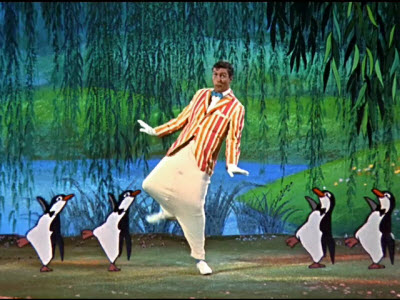
So let us behold the modern male - the middle class version by far the most egregious offender because he should know better - left to his own devices and 'free' to assemble from his wardrobe some suitable 'leisure-wear' for the same party.  Here he comes, shuffling up the path in his shop-faded and distressed denim 'jeans', the crotch of which - whether he wears a belt or not - hangs between groin and thigh, so that he could in silhouette pass for Dick van Dyke’s penguin impersonation in Mary Poppins. Above the waistband of these poke his undergarments, turning this most intimate of apparel into a crude and intrusive advertising hoarding for a pants-peddler, and thus which for its intended effect demands that it be visible, inverting the traditional and surely correct purpose of underclothes. His t-shirt advertises a television programme, a band or a film, or might contain an obscene or 'ironic' slogan, but is in any event unlikely to be free from a design of some sort.

If he wears a shirt – and there’s formal for you! – and if it has tails, it will announce the fact as they protrude from his clothes - violating the very purpose they serve. His sneakers are laced badly, if they are laced at all - it is rare that I find myself at one with the Health & Safety Executive but that surely is no practical example to an infant.

In extremities of cold weather he sports an artificial-fibre fleece or other leisure wear - redolent more of the north face of the Fellhorn than the North End Road - and resembles nothing so much as an infant in a romper suit. The ubiquitous beeny hat crops his skull, giving it the ovoid, featureless appearance of the babe in arms, and conceals, if not male pattern baldness then probably not a haircut but a hairstyle - probably the only aspect of his appearance to which he has given any but cursory thought, and quite possibly spending longer 'styling' it, and with more products, than his wife.

Allow me a moment as I try to recall occasions on which my grandfather deliberately displayed his underwear or had his shirt-tails hanging out in a public space…

Nope... Nothing springs to mind.

Well, I do not say definitively that this occurrence could never have happened. It is in fact possible to hypothesise circumstances in which both events might indeed have come to pass, although surely the two developments would be related, and gin would probably be a common factor if there were no other. But it would have been a point of shame for him, an example of a regrettable lapse of judgement or sobriety. It would certainly not have arisen as a result of a deliberate decision, made with a clear head, that it was acceptable to leave the house in such a state, still less that it would be regarded by his peers, not as an embarrassing error requiring immediate correction, but as a ‘valid’ ‘expression’ of his ‘lifestyle’. That it is possible for young men to entertain such beliefs, and for those who shape and dictate 'style' to those impressionable and vulnerable waifs to encourage them in that, surely erroneous, belief before my grandfather's cohort are even cold in the ground illustrates the dizzying speed with which our standards deteriorate, and the difficulties inherent in any attempt to not only arrest but reverse that decline. It surely cannot be too alarmist to predict that, within the lifetime of my younger readers, it will be acceptable for an adult British male to wear a nappy and suck on a dummy.


The Member for Kirkcaldy and Cowdenbeath relaxing at home.

How has this come to pass, and why is it sustained?

The brilliant Michael Bywater - I feel like I demean him just by citing him in this blog - addresses this tendency in his excellent Big Babies (link opposite and extract here) where he notes the distinction between a hat and a 'hat' - that it is now impossible simply to wear a hat, and that doning that item makes you, to other people, 'a hat wearer'. All our consumer choices have been made - by advertisers and that strange breed known once as 'trouser journalists', their parasites in the 'style' media - into 'lifestyle' choices, in which once-simple decisions - 'It is starting to get cold. I need a hat.' - have significance forced upon them. Bywater - forget Craig Brown, he is the funniest writer in England today, a sort of print Jonathan Meades -  de-constructs advertising and 'brand positioning' for watches, targeting Pulsar and Seiko (pitting what the advertiser tells you that 'owning a Pulsar' says about you against what owning one really says about you - which is best summed up as 'I can't afford a Seiko') and the phenomenon of the pilot's watch.

He is particularly sharp on the dismal Patek Phillipe adverts run in the Spectator - the ones populated by generically 'handsome' models presumably chosen for their fancied resemblence to, for example, a southern European aristocrat who looks like he has a successful carrer in global finance, or at least a Home Counties bigamist doing a passable impression of one, looking paternal towards a sullen and badly-raised IdentiKit son, staring with dumb insolence beyond the camera to the nasty plebs, a demeanour occasioned no doubt by the realisation that his parents have pimped his arse to the agency for money.

'You never actually own a Patek Philippe. You merely look after it for the next generation.' As Bywater notes, the 'actually' and 'merely', despite appearing redundant in terms of the construction of the sentence, are crucial. If you never 'actually own' one, implicitly you 'never actually' spend the £3,000 to buy one; and if it's really for young Konrad here, why, it's not being selfish, it's an investment; et, entertainingly, cetera... 


Arbeit macht frei, Kraft durch Freude etc

He then goes on describes a former neighbour who had a 'hunter-gatherer' uniform for his trips to Waitrose - the full early 80s Sloane Ranger get-up, Hunter wellies, Barbour, Tattersall check shirt, tweed coat, flat cap etc.

While Bywater is, to my mind, spot on in the fraudulence and pretty transparent insinuations of the advertising-trouser hack interface of deceit, he doesn't make the, to me, obvious connections between the broader social trend towards infantilising - everyone, from the sign on the Tube to the Prime Minister, talks to you like you're an idiot who needs protecting from himself and the consequences of his decisions, and then makes your decisions for you - to the specific, concrete examples of the man-child, the 'kidult', who has been cut adrift from himself by the erosion of 'the rules' of dress, has no personal frame of reference from which it is 'cool' to draw guidance, and consequently has to be told what to wear by strangers and companies.

To me, the crucial point is that, even if his Barbour-clad neighbour had his choices influenced, if not dictated, by Peter York, the FT Weekend 'Life & style' section and Country Life, at least the appearance he has cultivated is identifiable - to a child - as 'an adult', if not as an adult. At least there is a visible gap between the style of the nursery and the style of the drawing room. At least there is evidence of difference, and hence the existence of boundaries and the possibility of authority that this implies. At least, by asserting or implying that 'this is how an adult/an 'adult' dresses,' it does not betray the crisis of authority implicit when a father dresses like his son.

Far from the ludicrous assertion by the absurd Danny Baker, spewed from his maw at the height of the 'lad' cult of the mid-90s, that his 'generation' is the first to be 'cooler than our kids', it is more likely that his media cohort is the first to have achieved the influence to be able to make such a stupefyingly crass comment and expect listeners to admire him, when the proper and surely instinctive responses are, depending on your pre-disposition, either to feel sorry for him and hold him up as an example of what can happen if you don't eat your greens/tidy your room/stop touching yourself 'down there'; to put him on the naughty step for a good long think about he's just said; or, for the more traditionally-minded, to take his trousers down and give the little bleeder's arse a damn good tanning.


This man thinks he is cooler than his own children.

There is a regression at work here that is neither laudable nor particularly amusing in what it suggests about contemporary British society.

The only proper response is to look such folly in the eye and, recycling, as a more achievable and therefore more morally serious statement of intent, the vacuous posturing of the Iraq anti-war crowd, say ‘Not in my name!’ I do not want the next generation of Bumwad reminiscing about their father and, in their minds’ eyes, to see a slovenly, slack-jawed oaf in a t-shirt, belching and stumbling across the lawn with his trainers hanging off and his denim trousers around his ankles.

There is probably a deflating, self-mocking punch line to that paragraph, but I cannot think of one.

Nighty-night.

Tuesday, 26 October 2010

Weddings Part 3: London Match*

A very dear friend from university was married a couple of weeks ago in central London, mere stops up the Piccadilly Line from the Bumwad pied a terre, in Halkin Street at the Caledonian Club (aka the Scottish embassy). It promised to be a truly joyous occasion, and one of the few weddings I have looked forward to without reservation.

One of those reasons was purely selfish. As an adoptive Londoner, weddings in the city are always most agreeable because one is not made captive to the unscrupulous and rapacious demands of the provincial hotelier, traditionally the most chiselling breed of scoundrel, notorious for his determination to rob blind at every opportunity the starry-eyed and naïve visitor from the capital, unmanned as he is by the smell, bustle and endless noise of the countryside, and reluctant to give offence to his occasionally less self-effacing cousins.


And apparently some people think bankers are greedy
Thanks to the hosing down with cheap money - from the credit fire hydrant tended by the Brown-Balls axis of evil - given to rural Britain and its cohort of agri-businessmen, intensive farmers, former Stasi hobby B&B owners, gypsies, travelling tinkers and milkmen, no longer can a couple of metropolitan swells like yours truly and his trusty retainer The Snookmeister enter a rural inn at 11 a.m, drink fourteen pints of ye host’s finest foaming nut-brown ale, eat enough packets of Big D peanuts to work out that the comely maiden on the cardboard backing is – what a swizz! - wearing a bikini, spin a dozen magic tunes on the juke box (latest addition – Now 17), accidentally say 'cock' in front of a minor, hog the pool table for two hours, purchase protection from the local tough guys with cider and tinned salmon, be sent home reeling at two a.m. and still have change from a tenner. Oh no.


The author and his trusty companion The Snookmeister
in the good old days

Now even the meanest village boozer routinely charges prices for second-rate and chewy bitter, at best optimistically but almost certainly fraudulently described as 'best', farted inexpertly from a gas-assisted pump by an educationally subnormal and semi-literate adolescent with an aggressive STD, that would appear exorbitant in the most achingly bleeding-edge pop-up bar in Clerkenwell.
As for food, the less said about the belief, apparently widespread beyond TfL Zones 1-2, that slow-roasted pork belly - prepared ideally to the directions of notorious fat-tongued Mockney fascist twat Jamie Oliver - represents the snow-capped summit of culinary achievement the better.

And, if by any cruel ordering of your fate you should be forced by environmental disaster into engaging a 'suite' of poorly-proportioned and lamentably decorated rooms, or tempted on a whim by misguided fancies of finding a hidden, 'unspoiled' good-value gem into negotiating the entirely arbitrary rules on ordering food - 'last orders was at 1, kitchen shuts at 1.30' - and by pleading impending malnutrition find yourself permitted to order a miserable spadeful of 'home'-'made' sponge-cake coated in a mud-like confection, bearing a tiresomely playful passive-aggressive nickname intended - at a time of the owners' dictating - to bully your lady friend into ‘naughtily’ having a tenth-rate pudding on which the profit margin is around 400%, chosen from a laminated menu in 'Lucida calligraphy' font, proffered by a surly central European with fat ankles and an inflated sense of her ability to apply her boss’s orders to work the femme fatale vibe, one is harassed by email for weeks thereafter to make childlike cooing noises about the ‘friendliness’ of the experience on TripAdvisor or Google.
Well, mirabile dictu, not for Mr & Mrs B this unfortunate ritual. Oh no. We left Bumwad Junior (or 'BuJu' as she is known to the tabloids) in the capable hands of our fragrant and beautifully-mannered Oriental baby-sitter, knocked back a few quiet preparatory pints in the Nag’s Head and had a light and sensibly-priced lunch at Zafferano, before taking a jaunty stroll across Belgrave Square for the appointed hour. Better than paying £25 for a plate of disintegrated hog flesh and a greasy glass of fizzy faux continental lager in The Horse-rapist's Arms. And we were home to Bumwad junior by 6pm, saving £10 on baby-sitting. As the fat-tongued twot would doubtlessly slavver, semi-intelligibly, "Happy days..."
But if the London wedding posed far less of a logistical challenge than that presented by the long haul to Orta San Giulio, it did raise certain questions at the socio-sartorial nexus that required a few ‘from first principles’ thoughts.
First, there was no clear direction on dress, beyond a sort of ‘wear what you will’ pseudo-clarification in the FRAGO to the OPLAN. Secondly, it was for one of the participants a second wedding, but for the other it was their first, and, we fervently pray, only, dipping of their toes into the marital waters. Although the earlier marriage had not been annulled, no informed observer could regard that unfortunate episode as fully a marriage, even within the looser terms of the Anglican rite in which it was performed, involving as it did a level of dishonesty that would have been remarkable on the pages of Take a break, and certainly nothing to be wished upon an old and much-loved friend. None the less, to one such as me, with my doctrinaire tendencies, this would surely have to be a consideration.

Thirdly, instructions directed at the significant service contingent suggested that, if uniform were to be worn, many would turn to Service Dress rather than the more formal orders, worn rarely except on public duties. As the more technocratic, female-heavy (and heavy female) corps are rarely called upon to discharge such duties, as a rule their officers do not possess the more formal orders of dress. It should be noted of course that service dress is the correct attire for a military wedding conducted in war time - but could one trust today’s brand of junior officer, typically a product of the meritocratic society, to know that? And Service Dress is the military equivalent of lounge suits, despite appearing to the modern Briton unfamiliar and therefore somewhat more formal. But if there were to be a guard of honour and Number 1 Dress (Levee Order) were the 'squad solution', surely the proportionate civilian response should be morning dress?

This was shaping up to be an encounter with the matrimonial version of the Keynesian beauty contest, of which I spoke in an earlier post. 

[7.jpg]
Pondering some last-minute amendments to the best man's speech
(wartime option)


An Intelligence Corps subaltern in barrack dress
Now, as the blushing bride had in an earlier incarnation worked as an interior designer, and has always been a girl who takes some notable and successful efforts with her presentation, it was obvious that she would not be wholly oblivious of her guests’ attire, despite the distractions of the day. Equally it seemed likely that, being a fairly staunch traditionalist herself, she would observe convention and be reluctant to go the full nine yards by wearing an elaborate trousseau. It was, after all, a civil service, and her outfit must surely be in some way proportionate to the dignity of the occasion.

But, at the same time, even if she had not formally written off marriage #1, it was as if it had never been – and it would be churlish to present one's self in a lounge suit and to maintain that this was the correct gear and that the rest of the guests and the wedding party themselves were wrong. As the cloth-eared priggish route is precisely that which my twenty-year old self would have taken, I have some small measure of pride in the blossoming maturity illustrated in my perception of the unsatisfactory nature of this course. The longest journey, after all, begins with - well, something or other.
For confirmation of this tentative sketching of a solution, little could be gleaned from my inadequate knowledge of the groom. All I knew – thought I knew – of him was that he was some kind of investment banker, and that he had once been an accountant. I had no idea how old he was – from our brief acquaintance, it seemed he could be a prematurely aged thirty-year-old, or a youthful forty-five. After all, having read American psycho, I know how carefully those bankers look after themselves.


An investment banker relaxing at home.
(Note effects of thorough skin-care routine.)
Accountancy suggested a concern for details, but the very few accountants I know take an interest in their appearance that could charitably be described as visible, attending as they seem to observe basic rules of public health and decency, but which is certainly far from obsessive. Would the man of detail predominate, or would the practical man of business? This avenue was turning into a cul de sac.

Matters were confused further by my flirtations with continental weddings this year. I have become quite seduced by the low-key, quietly elegant approach, and which we discussed in the last post. Indeed I remain confident that, in a plain, dark blue suit, I am more effortlessly debonair than many a meaner figure in morning coat, silk topper and spats.
Reader, of course, I erred on the side of caution, driven by my intuition, like that of many a lower-middle class woman of a certain age contemplating the cancellation of a soiree in the aftermath of Princess Diana's death, that 'it's what she would have wanted'... Morning coat it was to be, and hang the effort, discomfort and mild flirtation with over-dressing that it represented...
In the end, this proved wise. The squad average was morning coat, reflecting no doubt the relatively high proportion of army officers, with a few smart suits for the 'creatives'  - and those determined to simulate the appearance, if not the work ethic or output, thereof - and the teenagers. Indeed, if we were to stand back and regard the scene on the grand scale - perhaps with David Lean directing (though surely he would have struggled to expand the constraining dimensions of the courtyard of the Caledonian Club to fill a Panavision screen) - we would see a profusion of dark cloth and waistcoats, of floral patterns and fascinators. As it should be.

It would only be through the lens of a Mike Leigh or a Noah Baumbach that we would notice the smear of lipstick on the teeth, the rogue bra strap, the badly-knotted half-windsor - It would be mean-spirted to recall such details, of course - but this isn't the best man's speech or the wedding album, but a sort of post-match commentary. If we are ever to learn, it is important that we must recognise our mistakes as much as our successes, and that's the point of this post, indeed, of this blog. I'm the thorn in your shoe, the python in the toybox, the prostitite who calls your wife.
Not literally, of course.
Now, in spite of some commonly-agreed basics, 'morning dress' is not a fixed entity: much is determined by the way in which the basic articles of the outfit are assembled and worn. Like austism, one's own version of morning dress exists on a spectrum. Like army officers for whom 'uniform' is a noun not an adjective, and among whom it is rare to find any tw dressed alike even when nominally in the same rig, on this occasion there was an array of appearances.

My own morning coat - the result of a tortuous and extremely demoralising process that resulted in a permanent divorce from my then tailor - is a pretty standard black Melton cloth with a very fine herringbone, and silk piping on the lapels and most edges. I also had turn-back cuffs applied - one of the points of friction with the cutter - and button-holes on the points of the tails, to give fresh life to the vestigial buttons in the small of the back, to which the tails were fixed when riding or otherwise seated. This I wear with a black double-breasted waistcoat and sponge-bag - houndstooth - trousers, and plain black shoes, usually a monk shoe but sometimes a simple slip-on. I usually wear a dark tie from Mrs Willis. Her ties are discreetly patterned - her shepherd's check are particularly smart - and of a very good weight for morning dress. I usually wear a white or pale blue shirt from Mr Budd, with a stiff collar and double cuffs, with plain silver cufflinks; or a plain silk shirt with my cherished cocktail cuffs if I feel dangerously avant derriere.

(One of the reasons I have been tempted in recent years away from morning dress is my deep dissatisfaction with my morning coat. The turned-back cuffs are lined, wholly impractical for cloth of that weight, and so do not lie correctly. The cloth has too much spring in it, so the seams bulge and pucker, even when the garment is hung. The chest-pieces do not float so much as fly, granted wings by the patron saint of shitty workmanship. Above all, it just does not fit. The man who made it left the company before it was finished, and his colleagues struggled manfully to correct the errors, but to no effect. It was with some amazement that I read that the buffoon who built it is now masquerading as a head cutter - head cutter! Not shit-boy or hat-stand! - at an established family firm on Savile Row. Truly staggering, like making Gordon Brown director of the IMF and World Bank. (This of course could actually be entertained as a serious proposition in the Bizarro World in which Labour claims to speak for the middle classes and a gurning adenoidal wonk can become leader of the party of Attlee and Healey...) I am tempted to show his current employers my morning coat and invite them to reconsider - but that would be wanton cruelty. Also, the tightwad in me rejoices somewhat that the firm employs not only grossly incompetent craftsmen but grossly incompetent billing staff, who have failed to charge me the balance in spite of my - admittedly not exhaustive - attempts to seek clarification from them...)

But what I flatter myself to describe as 'attention to detail' is not observed uniformly, even by those types who default to morning coat. And on this occasion, there was indeed a profusion of the 'surly ten-year old' look noted in my earlier post: the exposed portion of midriff where trousers and waistcoat are reluctant to meet; the tie that does not fit the collar; the collar that does not fit the shirt or the neck; the dirty shoes; the garish waistcoat or 'fun' socks that squeal that "I'm fun!!! Just because I work in an office doesn't mean I have to be buttoned up to eleven!!!"

Richard Curtis, as usual, has much to answer for.


A target-rich environment


He couldn't even be arsed to comb his stupid hair.

Other than the novelty waistcoat, for which there really can be no decent excuse, one of these lapses, two even, might be excusable - provided it were the result of genuine haste, and thus possible to remedy, rather than the consequence of a desire to simulate the kind of pressure that distracts from attention to such matters, the desire to state by appearances either that the wearer has loftier things to ponder; or that, having given them thought, decided such matters are of little consequence; that he is, in effect, above or beyond the need for conformity.

Now, don't get me wrong: I'm not advocating that everyone look box-fresh and neat like Remington Steele. I'm a great one for wearing my favourite clothes until they are beyond repair. I dislike the feel of new clothes - a shirt is not comfortable until the fifth or sixth laundering - and a love for clothes need not - should not - be synonymous with a descent into omnivorous, undiscriminating, joyless consumption. There is much virtue on many levels in the traditional English horror of looking like an arriviste who has just bought all their clothes in one go - for example, the 'instant English wardrobe' pioneered by Hackett and which is typically availed by the Sandhurst-bound provincial or Euro banker who for reasons of time management, judgement or confidence are reluctant to make their own, informed and considered decisions - and in recoiling from any impression of ostentation.


I don't want this.

But it is possible to take the old practices of inverted snobbery and make them tiresomely conspicuous, and it is that fine line which is never so often - nor so violently - breached than at the modern British wedding. Yes, it is bad form to care 'too much' - but that does not mean that it is bad form to care.


But is this really too much to ask?

Too many young men - it is rare to find a lady of any background who thinks she is too important or too busy to need to make an effort - are today ill-equipped to appreciate that distinction. The customs, that once were written not in stone but on the hearts of men, exist now only in bastard form - a photocopy of a handwritten summary of a precis of some notes written from memory and inaccurately recalled, perhaps during a mirthless and drink-sodden supper, taken alone on the fourth anniversary of the death of a close relative. The rituals that reinforced the practice are diluted. The institutions - family, school, church, even employer - that would once have provided the moral framework no longer have themselves the confidence - or the authority - to do so. And if their tutoring has been inadequate, there is little hope for their children, for where will the boundaries of the next generation be set?

Their mothers, I suppose; but again we pile upon these blameless creatures, who typically provide sound sartorial role models for their daughters, responsibilities shirked either by choice or apathy by their fathers - or the tyranny of society's low expectations. 

Well, I suppose an optimist would say "At least they wore morning coats." To which the prig in me cries with exasperation "But why did they bother if they didn't want to do it properly? Isn't it frankly better not to have bothered than to have bothered and still managed to look like a blessed tramp?!"

I see I am now at risk of repeating myself, and at tedious length, so perhaps it is sensible to end here.

* The final volume in Len Deighton's first Bernard Samson trilogy, preceded by Berlin Game and Mexico Set and succeeded by Spy Hook, Spy Line and Spy Sinker, at which point he wasn't really trying on the titles front.

Wednesday, 13 October 2010

Weddings Part 2: An Italian Job

Being married to a member of the Piedmontese upper middle classes, I was fortunate earlier this month to attend a family wedding in northern Italy. Mrs Bumwad’s younger sister got hitched, like her elder sister and her, to an Englishman – a charming man – and, as is the custom, the bride claimed precedence when deciding the venue. So it was that we trekked to Lago d’Orta in late September, a journey undertaken by car because of Mrs B’s advanced state of pregnancy, which forced us to camp overnight in Beaune (presenting us with the opportunity to bulk-buy some of the fine local wines).


No, mine says "Welcome to Italy, have a nice day."

As a digression, the idea of a motoring holiday in Europe has always appealed strongly, but I had imagined it in somewhat different circumstances: an open-topped GT, some Scott Walker on the stereo, travelling the indirect route on a whim, punctuated with lazy lunches consisting of six inches of Lyon sausage, a loaf of bread, and half a litre of Macon with the cork pulled. As is so often the fate of dreamers, the reality did not measure up quite to the ideal. Our journey was undertaken in a knackered old VW Golf, piled high with shit belonging to friends who were flying and wanted to make our responsibility that which they did not care to entrust to BA, EasyJet etc, with an 8 ½ month pregnant wife and a two-year old daughter demanding constant and repetitive access to three specific tracks on the original cast recording of The sound of music, and achieved via the fastest (and most exorbitantly expensive) routes, with lunches inhaled at convenient though scarcely sanitary AutoGrills, and punctuated by frequent prayers that Bumwad Junior #2 would not arrive prematurely in a lay-by delivered with the reluctant assistance of a Yorkie-spattered long-distance lorry driver distracted temporarily by a small spark of human feeling from murdering hookers.
In fact, Bumwad Junior was a remarkably trouble-free motoring companion, and the combination of the mountain air and the enthusiastic trilling of various nuns was sufficiently distracting to enable her to sleep for much of the trip and to remain rapt for the rare conscious moments. Mrs B was able to rest in a degree of comfort, our overnight accommodation was exceptionally pleasant, and I like The s of m enough to bear repeated exposure to ‘Sixteen going on seventeen’ with good humour. Nonetheless it was with an enormous sense of relief that we finally arrived at our modest B&B on the southern shores of Lake Orta, divested ourselves of the paraphernalia that had been wished upon us by various aviating relatives, and began to engage with the wedding proper.


In-car entertainment system: Pick up a Penguin.
Being an overseas wedding, of course, it was a protracted affair, with friends and other family assembling at intervals from Britain, the USA, the Far East and parts of continental Europe. This meant that, in addition to the wedding itself, there was a series of more or less planned social occasions in the run-up, including a drinks party but more entertainingly various ad hoc lunches and suppers in which tables rather joyously swelled as more friends and relatives arrived by chance. These placed no obvious additional burdens on the wardrobes of those invited, which is only to be understood because few people arrived by steamship with a large accumulation of trunks in which to contain a multitude of outfits. As the English guests were predominantly middle class or aspiring/educated lower middle or upper working class, there was a riot of what might loosely be termed ‘tertiary education leisure wear’ – White Stuff, Fat Face, Jack Wills, and so on – as well as the odd dandy who wore a proper shirt. Denim of course predominated. (Indeed it would have been obtuse to have expected much in the way of linen or tweed, except in the odd waistcoat or cloth cap - those garments which have worked their way back into the wardrobes of the modern Briton as an everyday accessory, having been revived as ironic and lopsided tributes to convention in the catwalks of Milan or Paris, where they were probably described as ‘witty’ ‘references’ to Fitzgerald or the Duke of Windsor in gushing filler pieces by Hilary Alexander in the Telegraph.)
(By a strange co-incidence, a poetry convention was occurring in the town of Orta San Giulio, which did indeed leaven the lump of thirty-something casual wear with a profusion of egg-stained rumpled faux-bardic corduroy, linen and flannel: some parts of the town square resembled a Brideshead revisited production in which the costumes were sourced from the back pages of the Mail on Sunday colour supplement. Although I suspect that those late-middle aged gentlemen that could seen out and about in daylight were poetry enthusiasts rather than actual poets.)
It should perhaps be made clear at this point that my wife’s family might be Italian, but they bear remarkably little resemblance to the Dolmio adverts, the Corleone family or any other north Atlantic stereotypes: my father-in-law has never been heard to remark, even in fun, “Ay ay ay - that’s a spicy meatball...” and my sisters-in-law have little in common with Joey Tribiani’s female siblings. My father-in-law is a dapper little fellow with impressive grey moustaches, and my sisters have lived in England all their lives and sound far posher than any Bumwad that has ever walked the earth.

My sisters-in-law do not look like this.

In much the same way that Alpine villages in France, Switzerland, Germany and Italy look far more like each other than the villages of the rest of their native countries, so do both distaff families look far more like other western Europeans than they do the swarthy, sun-kissed inhabitants of Apulia or Basilicata. Northern Italy, as the Lega Nord would maintain, is a different country: this was no clash of civilisations, and the differences between the Italian guests and the Britishers was far less than might be expected at a wedding between a Cockney and a Geordie – or indeed between a Fifer and Glaswegian.
A Cockernee bride and the lucky Geordie fellow.
Frankly the Big Day did not pose that much of a challenge in terms of dress. Although, as I said in the last post, I’m by inclination a morning dress sort of person, I’m also happy to defer both to local custom and to the preferences of the hosts. And morning dress is traditional at none but the grandest Italian weddings so there was no serious question of wearing anything other than what is usually described as a ‘lounge suit’.

Although such a garment is regrettably indistinguishable from a ‘business suit’, say what you like about their political stability and fondness for male eyebrow sculpting, but the Wops know their onions when it comes to suits. Grown-up Eyeties are typically very smart in their own way, as a brief passegiata around Turin, Genoa, Milan or Rome on any working day will demonstrate. I attended earlier this year another wedding at which a Briton was betrothed to a Piedmontese, and it seemed to me that there was in the dress of the older Italians much more dignity and sense of occasion than at many morning-dressed English weddings. And this earlier exposure to Italianate matrimonial custom indicated that dark blue is the suitable colour, in a plain or very discreetly patterned cloth; and fortunately that describes almost all my suits (except for my ‘unacceptable face of capitalism’ chalk-stripe, which languishes unworn, a testimony to the folly of youth). This was the archetypal ‘no-brainer’.

It was not this type of wedding.
Besides, I knew from my assessment of my prospective brother-in-law that he was unlikely to possess a morning coat, and still less likely to buy or hire one for the day. A graduate of King's College, Cambridge, he is a man of the fixed, if somewhat studiedly eccentric, views common among alumni. But what is sometimes an admirable challenging of convention can too often seem like contrived rebelliousness, and often it seems he takes a non-conformist route almost solely for the sake of non-conformity. For example, while I doubt he would wear a revolving bow tie, I would not be greatly surprised to learn that he had worn at a black tie dinner a white tuxedo, or even a black shirt and white bow tie.

My brother-in-law might dress a bit like this.

It was therefore no great shock when he eventually appeared clothed in a peculiar dove-grey ensemble, consisting of a single-buttoned coat, a four-buttoned [sic] waistcoat and plain-fronted trousers without turn-ups. I think he wore a belt with it as well. Now, this rig was not to my taste, but in fact it looked pretty good: it was a step up from the sort of suit he might have worn to the office, which showed a sense of occasion; and could probably be recycled at future weddings at which he was not the groom without fear of looking overdressed, indicating a degree of parsimony that would appeal to most brides. He even eschewed the pointy clown-type shoes he customarily wears in favour of a pair of pretty conservative brown Oxfords of only mildly ‘contemporary’ design.
His bride, of course, looked beautiful. And, while it is only to be exected that a degree of effort and artifice went into achieving her ‘naturally radiant’ look, there was not the depressing, yawning gap between the elaborate confection and visible expense of the bride’s outfit and the grudging meanness of the groom’s. The newly-weds were in a state of admirable proportion and harmony, as it should be.
I, on the other hand, succeeded in blending in, while not being mistaken for an Italian; certainly I didn’t ‘upstage’ the groom; it was, all in all, a satisfying adventure.
This did not happen.
Incidentally, there were no ushers (see comment on previous post), which at the time seemed controversial, especially in view of the number of moving parts on the day - herding aging relatives from hotel to church to boat to circus train to reception. However it meant at least that we were saved the absurd and aesthetically barbarous practice of coordinating ties and waistcoats for ‘the groomsmen’. It is perhaps interesting to reflect as an aside that the matching tie and  handkerchief get-up was in less enlightened times the prerogative of the adult homosexualist, a sort of sartorial palare intended to signal discreetly to other gayers that the wearer was ‘good with colours’ and/or ‘a friend of Dorothy’ and yet to be undetectable to the local constabulary, who would surely have wasted no time in banging up the likes of Herbert Pocket on indecency charges – a sort of analogue version of Grindr, I suppose. Now, to regard the practice of coordinating such items as absurd and barbarous is not to cast any kind of moral judgement on the practices of our ‘gay community’; but I think, like many pleasures of the naughtier kind, coordinating accessories is best left to be practised indoors between consenting adults.

Tuesday, 12 October 2010

Weddings: Let’s all get dressed up to the sevens!*

I am at that time in life by which most of my friends are married, and those who remain unmarried are likely, for reasons of social ineptitude or eccentric standards of personal hygiene, to remain so. As a result, weddings have for a couple of years been few and far between. However, in a strange inversion of the norm, Mrs Bumwad and I have recently attended marriages on two consecutive weekends, and a third is imminent (and we were forced to decline attendance at a fourth which took place last month). The last will be a more or less traditional English wedding - church, reception, dancing - but the first two were somewhat sui generis, the first because it was an Anglo-Italian affair held abroad, and, as we all know, when in Rome…; and the second because it was the bride’s second marriage.

The bride and groom
So, although neither was a ‘typical’ occasion – if such could be said to exist – they nonetheless triggered some thoughts on the standards of dress now common at weddings, testing my long-held prejudices in favour of the traditional rig of a morning coat and spongebags. Deep and clear thinking was also occasioned because the prospective groom at Wedding #3 sought my advice, and it occurred to me that here was a useful way of clarifying my own thoughts before passing on the results. However, on writing, I found that my thoughts were more complex than I realised, so for purposes of clarity I have broken the posts into four bits. The first consists of some general observations about the relationship between the nature of ‘a wedding’ and the way we ought to dress if attending one; the subsequent posts will consider these two specific occasions; and the final one will try to summarise the few ideas discussed.
Needless to say the posts proceed on the assumption that the reader actually gives a shit about how they appear before fellow guests and does not regard the rite of marriage, the attendant legal obligations and the invitation to a sacred form of table commensality merely as an excuse for a free piss-up and the prospect of tapping into an as-yet unexplored sector of the opposite sex courtesy of the union before God of a friend with a hitherto-unknown other. A dangerous assumption, possibly. A wedding is all too frequently yet another of those occasions on which it is depressingly obvious that the ladies have spent some time and effort not only considering what they will wear but also upon assembling and assuming their appearance – in short, to have made considerable effort, even if with mixed results, to acknowledge the importance of the occasion. Yet to observe the appearance of most gentlemen guests is to observe a faithful recreation of the demeanour and attire of an eight-year old boy forced to attend a church garden party while Batman is on. Which is possibly to say that, to many if not most people, a wedding is a party with a boring bit attached – like graduation – and the requirement to acknowledge that the occasion has any more important social function or purpose is entirely optional, if not faintly contemptible; and different - 'better' - standards of dress are no more necessary than are different standards of conduct.


The boring bit.


The good bit.
My limited enquiries into the matter lead me to conclude that, for most people, weddings are pretty much the last sort of gathering in which any form of dress ‘code’ is observed. Or perhaps we might put it another way and remark that weddings are the only occasion on which many people will tolerate being told what they are expected to wear. Nonetheless even here we are increasingly vulnerable to the sort of confusion that is almost invariably the result when rules once instinctively understood and observed are adulterated: a wedding is yet another occasion which proves the paradox that ‘laws make you free’, and that the erosion of a commonly-accepted convention serves not to liberate but to oppress.
I always used to think it slightly pointless when invitations – not just to weddings – specified dress codes. Once it would have been as utterly superfluous to state ‘morning dress’ on a wedding invitation as it would have been to write ‘wear socks’, ‘shave’ or ‘please do not piss in the font’. Consequently invitations were confined to a simple statement of the date, time and place of the marriage ceremony, and an address to which to reply: no direction on order of dress was required, because it was taken for granted that gentlemen would wear morning dress, the appropriate uniform, or a national equivalent. These days, however, when it often seems that the only reluctant concession to the solemnity of the occasion even by the groom is that he was worn his favourite t-shirt and cleanest ‘trainers’, no such assumptions can be made; yet too often one turns to the invitation for guidance only to emerge from the experience wholly unsatisfied.

The best man's speech.

Strangely, whereas invitations commonly omit any sort of guidance on dress, it is now quite normal for them to be accompanied by several pages of notes, typically run off on the office laser printer, folded and stuffed into the envelopes along with the double-folded copperplate cards so that in size and weight they resemble nothing so much as the laminated ceramic ballistic plates inserted in the front of body armour. These specify in elaborate, and often illustrated, detail the location of the church and any reception venue, the addresses and telephone numbers of local hotels, taxi companies, ayurvedic yoghurt analysts and child nutritionists, as well as the timings of the local farmers’ markets and queue lengths for the rides on the local theme parks. This is all very well-intentioned, no doubt, but the level of detail these ‘admin instructions’ provide has expanded in proportion - and consequently their usefulness has declined in inverse proportion - to the availability of the information they contain. After all, the ability to find and book a hotel and a taxi, even in some far-flung outpost of empire like Carshalton Beeches, ought, particularly in ‘the information age’, to be the sort of implied task the achievement of which is a scarcely laudable mark of adulthood.


Fall WEISSE HOCHZEIT DTG 29 Oct 2010: Detailed location of church, Reception (the Swan and Asbo), Relate office and holding cells 

And the one bit of information that is not readily available on the internet and is unlikely to be uncovered by intuition is what the bride would like her guests to wear.
Now, sometimes it is possible to deduce it with a degree of confidence from marginal information – for example, an assumption that ladies will wear hats is a good indication that men are expected to wear morning dress. Yet too often any further inquiries will reveal only the breezy exhortation to ‘wear what you like!’ This is no doubt intended to be both a helpful liberation from the burdens of expectation and conformity that so blighted our grandparents’ lives, while simultaneously announcing the lack of pretension – and therefore the suitably non-judgemental outlook – of the hosts or prospective spouses. This is of no help at all, as it forces one into the sartorial equivalent of Keynes’s beauty contest: you have to do not what you believe is correct, but what you think everyone else – or at least the bride and her parents – thinks is correct.
(I observe as an aside that, while couples or parents are reluctant to give clear direction on dress for fear of being thought too ‘uptight’ or authoritarian, they are only too happy to be highly prescriptive when it comes to gift lists – or, indeed, the increasingly common and massively self-indulgent requests for donations to charity in lieu of presents, which betray an almost perfectly wrong-headed understanding of the purpose of presents...)
This inverts the natural order of such things, in which it is not what *I* think or like that is at the heart of my attendance, but what the bride and her family would like. It is therefore in a small way an abrogation of responsibility, however laudable in its intent to avoid excessive formality. Cleary there is a balance to be struck, and I do not wish to imply that 'mere' appearances are of central importance on such a day, but it remains possible that if the couple have given no serious thought to the way they wish their guests to conduct themselves, it is possible that they have not given full consideration to the nature of the contract they are entering. To stipulate a different sort of dress for a wedding is not to privilege appearance over substance – to champion ‘dressing up’ for the sake of ‘dressing up’ – nor is it to be a ‘Bridezilla’, but simply to ask one’s family and friends to acknowledge in outward form the essential truths that a wedding represents - even if the precise doctrinal nature of the marriage is not shared by all one’s guests.

Now, if, having reflected on the matter, the bride et al sincerely want their friends to dress only for comfort, or as they would for a day in the office or a court appearance, then that is all well and good, particularly if this is in tune with the overall plan for the day – modest church service, a few friends and family for a fork buffet at local pub, cash bar, disco. But for many weddings – the average cost of a wedding in Great Britain is over £21K, FFS! – a failure to ‘dress up’ to the occasion is to risk undermining what should be a serious – if not actually sacred – undertaking, and is to risk your friends and family treating your ‘big day’ with all the dignity and joy that they would the office Christmas party.
In those circumstances, one faces the dilemma: does one ‘dress up’, and risk looking like you’re trying to upstage ‘the wedding party’, or worse still, that you are not living life to the max? Or does one err on the side of the ‘democratic’, and embrace the ‘informal’, the ‘modern’, entering into the Zeitgeist of our bright modern Britain, in which to be seen to uphold any vestige of old-fashioned standards is one of the last secular sins, along with racism, homophobia? After all, dressing smartly is what the Victorians did, and we all know what a bunch of intolerant, oppressive hypocrites they were [sic omnia]. Indeed, runs the unspoken logic, presenting an outwardly smart and dignified appearance serves only to amplify the fallen human condition and is itself an act of pure hypocrisy. Oh yeah - you might look fine and grand, but we all know you just looked at that woman's tits, and you're trying to get another look, only without making it look like you're looking at them. You sit there in your clean shoes, with only your braces keeping your trousers up, a seething mass of base urges barely constrained by your collar studs and waistcoat... Oi oi, while you're down there, love..! Heh heh heh..! Mine's a lager. Heh heh heh!


You think you're so smart in your top hat...

So we flail around to find some kind of compromise that acknowledges that we have made an effort but without looking like we have made too much of an effort. We find, in short, ‘the middle way’. So, instead of getting dressed up to the nines, we get dressed up to the sevens.


The middle way (centre)
And there will probably be someone who goes for the fives (or fours), possibly because they really don’t know any better, maybe because they genuinely don’t care, but equally possibly as an expression of disregard if not contempt for conventions because their own comfort and sensibilities – and not the bride’s – are their arbiters. And woe betide anyone who miscalculates and goes for the eights (or, God forbid, the nines) as they will in many circumstances feel far more conspicuous than the t-shirt-clad, multiply-pierced colleague, and will have to pay for dry-cleaning and re-starching to boot.

The ushers

But this is another example of the wedge of apathy managing to insert its thinnest edge into proceedings: once you concede that morning dress is ‘too stuffy’, there is no logically defensible ‘backstop’. If not morning coats, why ‘lounge suits’? Why ties? Why, indeed, socks? Why, we might reasonably, if exasperatedly, ask, bother at all? Surely it is enough just to be there for my friends, and if that means I am ‘there’ in my underpants and slippers, so what? Get a life, you anally-retentive twat.


Why bother?
Except, I hope I need hardly add, that by disregarding the conventions that others have observed you would not really ‘be there’ at all.
To exceed the remit of this blog, it seems to me that this reluctance to give clear direction on what is expected even on a matter as outwardly trivial as dress represents a further example of the erosion of the moral courage of the middle classes.
So again I find I have written a post which reinforces that I favour a more conservative approach as a principle, as well as voicing one or two peevish cavils at what is, my own wedding excepted, effectively none of my business. In the next two posts I will examine the two October weddings, as each presented unique challenges from which I hope, in some kind of summary post, to draw some general principles.
* Hat-tip: Boni

UPDATE: I suppose what I'm saying is that these days it is increasingly acceptable for adults to behave like children; so if, by some quirk of good upbringing you have managed to preserve your sense of decorum in the face of the mediocrity of modern life, and actually *do* give a shit about how your marriage is conducted, it's wise to err on the side of caution and give all your guests the sort of clear instructions you might to a child, hoping that it is for most superfluous. And if some of them still insist on dressing like an extra from Skins, at least you can make a mental note never to have them in your house.